
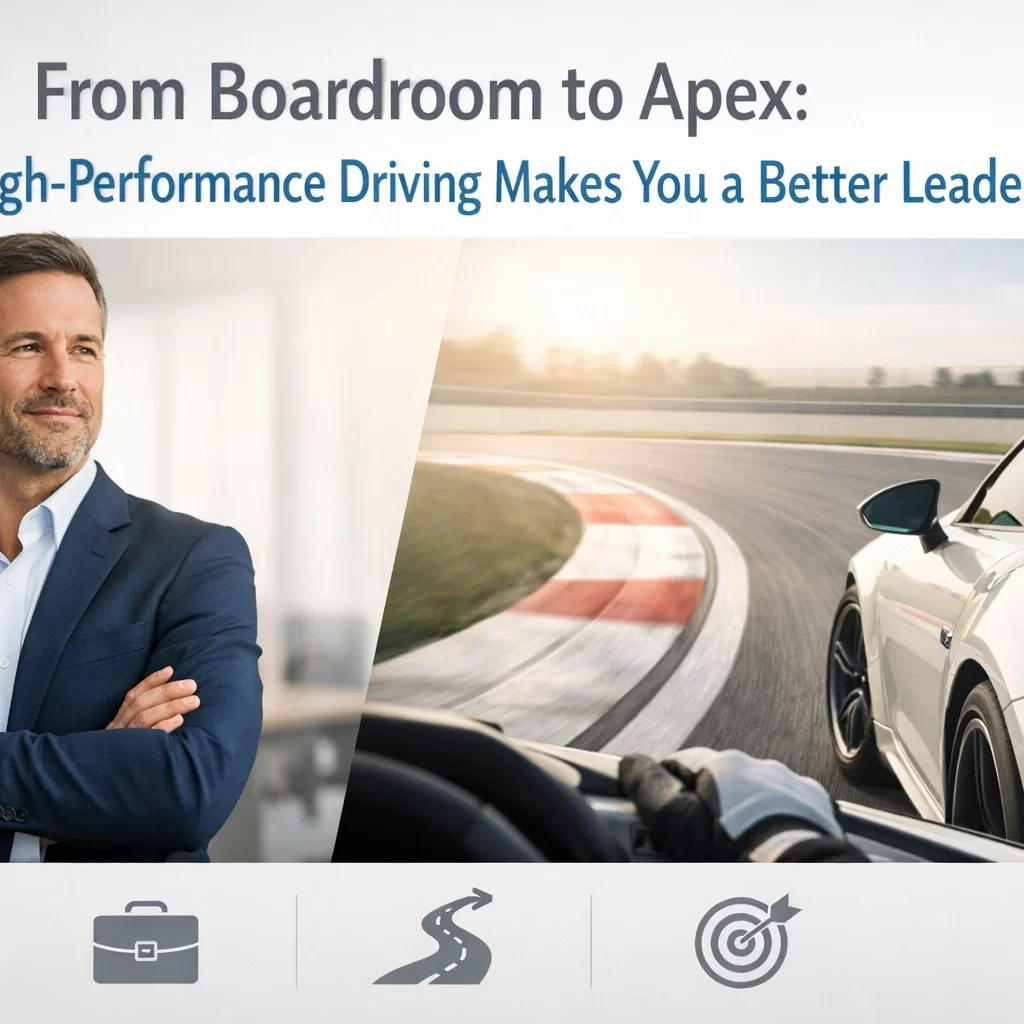
Ever wonder why so many CEOs and executives are drawn to high-performance driving? It’s not just about the adrenaline rush or the prestige of a track-ready Porsche. There’s something deeper happening when you’re hustling through a chicane at speed, something that translates directly to the corner office.
The connection between high-performance driving and leadership isn’t coincidental. Both demand split-second decision-making, complete situational awareness, and the humility to know you’re always learning. Whether you’re navigating a decreasing-radius turn at Laguna Seca or steering your organization through market turbulence, the skills overlap more than you’d think.
Vision Beyond the Windshield
Ask any racing instructor what separates fast drivers from truly quick ones, and they’ll tell you the same thing: vision. The best drivers aren’t fixated on what’s directly in front of their hood. They’re looking two, three, even four corners ahead, planning their line, anticipating changes in elevation, and setting themselves up for the next move.

Sound familiar? In the boardroom, leaders who succeed are the ones with clear vision beyond the immediate quarter. They establish direction, communicate the destination, and empower their teams to follow the roadmap. Just as a driver who stares at their front bumper will inevitably crash, leaders who focus only on today’s fires will miss the strategic turns ahead.
This forward vision reduces organizational anxiety. When your team knows where they’re headed, even if the full route isn’t visible yet, they can focus on execution rather than worrying about direction. You’re giving them the clarity to perform at their peak, just like knowing the next three corners lets you carry more speed through the current one.
Shifting Gears: Adaptability Under Pressure
High-performance driving isn’t about being flat-out all the time. The fastest lap times come from knowing when to accelerate hard out of a corner and when to brake deep for a tight hairpin. It’s about reading conditions, track temperature, tire wear, traffic, and adjusting your inputs accordingly.
Leadership demands the same gear-shifting mentality. Sometimes your organization needs aggressive acceleration: launching a new product, capturing market share, or executing a major initiative. Other times, you need to apply the brakes: during restructuring, market downturns, or when your team is stretched thin.
The best leaders, like the best drivers, develop an intuitive sense for which gear the moment demands. They balance assertiveness with empathy, knowing when to push and when to provide support. They understand that leading through a challenging period requires a different approach than driving growth during favorable conditions.
Reading the Track: Know Your Terrain
When I first took a 911 GT3 onto a proper circuit, the instructor told me something that changed how I think about both driving and leadership: “The car is capable of far more than you think. Your job is to understand the track well enough to use that capability.”

Every track has its unique characteristics, blind crests, off-camber turns, elevation changes that upset the chassis. The drivers who excel are the ones who study the terrain, learn its nuances, and adapt their approach to each section. They don’t drive the same line at Sebring that they’d use at Road America.
In organizations, this translates to truly understanding your people. Regular one-on-ones aren’t just HR box-checking, they’re your track walk. These conversations uncover each team member’s strengths, challenges, motivations, and pressure points. Armed with this knowledge, you can tailor your leadership approach to the individual, maximizing their potential while supporting them through their weak points.
Just as you wouldn’t take the same line through every corner, you shouldn’t manage every person the same way. The terrain varies. Your approach must vary with it.
Humility at 150 MPH
Here’s what high-speed driving teaches you faster than almost anything else: you don’t know as much as you think you do.
Even after years of track days, there’s always someone faster. There’s always a better line. There’s always something new to learn about weight transfer, threshold braking, or managing oversteer. The moment you think you’ve mastered it, the track will humble you, sometimes literally spinning you into the kitty litter.
This forced humility is one of the most valuable leadership lessons the track offers. Great leaders practice intellectual humility: listening more than speaking, asking open-ended questions, acknowledging when they lack answers, and learning from team members regardless of title or tenure.

When you’re willing to say “I don’t know, but let’s figure it out together,” you create psychological safety. Your team feels empowered to contribute ideas, challenge assumptions, and collaborate authentically. This mirrors the dynamic between driver and instructor, the best learning happens when ego takes a back seat to curiosity.
Furthermore, humility keeps you coachable. Markets change. Technologies evolve. Customer preferences shift. Leaders who maintain a student mindset, who approach challenges with the same openness they’d bring to learning a new track, position their organizations to adapt and thrive.
Total Presence: The 100% Rule
On track, distraction equals disaster. You can’t check your phone mid-corner or let your mind wander to tomorrow’s meeting. High-performance driving demands total presence, every sense tuned to the feedback coming through the steering wheel, the sound of the engine, the g-forces pushing you into the seat.
This complete attention develops your ability to anticipate and react. You learn to feel when the rear is about to step out before it happens. You sense when you’ve got more grip available. You read subtle cues that allow you to extract maximum performance while maintaining control.
Leaders who cultivate this level of presence make better decisions. They pick up on team dynamics during meetings. They notice when someone’s disengaged or struggling. They sense organizational momentum shifts before they become obvious in the metrics. This heightened awareness, this ability to read the room as precisely as a driver reads the track, separates good leaders from exceptional ones.
Collaboration Makes You Faster
Here’s something many people don’t realize about high-performance driving: it’s rarely a solo pursuit. Yes, you’re alone in the cockpit, but behind every fast lap is a collaborative effort: instructors providing feedback, mechanics optimizing setup, fellow drivers sharing insights about line choice.
The same principle applies to organizational performance. Companies that prioritize collaboration, agility, and continuous talent development consistently outperform those built on individual heroics. Racing teams understand this instinctively. Formula 1 teams don’t succeed because they have one brilliant driver: they succeed because hundreds of people collaborate with precision.

As a leader, your job isn’t to be the fastest driver: it’s to build the fastest team. That means creating systems where information flows freely, where people feel safe taking calculated risks, where failure is treated as data rather than disaster. It means recognizing that your organization’s potential, like a racing car’s, far exceeds any individual contribution.
Understanding Limits: Yours and the System’s
Every car has a limit: the point where physics takes over and no amount of skill can save you. Great drivers spend their careers learning to dance right at that edge without crossing it. They develop an intimate understanding of where grip ends and chaos begins.
Leaders face the same challenge. Every team has capacity limits. Every market has saturation points. Every strategy has boundary conditions where it stops working. Understanding these limits: truly understanding them, not just intellectually but intuitively: allows you to maximize performance without breaking the system.
This doesn’t mean playing it safe. The fastest laps happen when drivers use every bit of available grip. But they achieve this by respecting physics, not defying it. Similarly, great leaders push their organizations hard, but they do so with full awareness of structural constraints, capacity realities, and human limitations.
When you ignore limits, things break: spectacularly. When you respect them, you can operate consistently at high performance, which over time beats occasional heroics followed by crashes.
The Long Game
High-performance driving, like effective leadership, rewards patience and consistency over flashy moves. The drivers who consistently turn fast laps aren’t the ones making dramatic saves and posting highlight-reel moments. They’re the ones running smooth, calculated laps where every input serves the overall time.

Your leadership is the same. It’s not about the big speech or the dramatic turnaround moment. It’s about the daily decisions: how you respond when someone makes a mistake, whether you follow through on commitments, if you maintain your principles under pressure. These small, consistent choices compound over time into organizational culture and performance.
From Cockpit to Corner Office
The next time you’re facing a complex business decision, think about what you’d do approaching a fast corner: look ahead to where you want to be, not at the problem directly in front of you. Read the terrain and adapt your approach. Stay present and trust your preparation. Respect limits while using all available capability. Maintain humility and remain coachable.
These aren’t just driving principles: they’re leadership fundamentals proven at speed. Whether you’re heel-toeing into Turn 9 or navigating your organization through disruption, the skills are transferable. Both require vision, adaptability, presence, and the wisdom to know that mastery is a journey, not a destination.
So maybe those track days aren’t just a weekend hobby after all. Maybe they’re leadership training in the most visceral form possible: where the feedback is immediate, the lessons are undeniable, and the parallels to business are impossible to ignore.
The apex of the corner and the apex of your leadership career might be more connected than you ever imagined.